Request Echoer
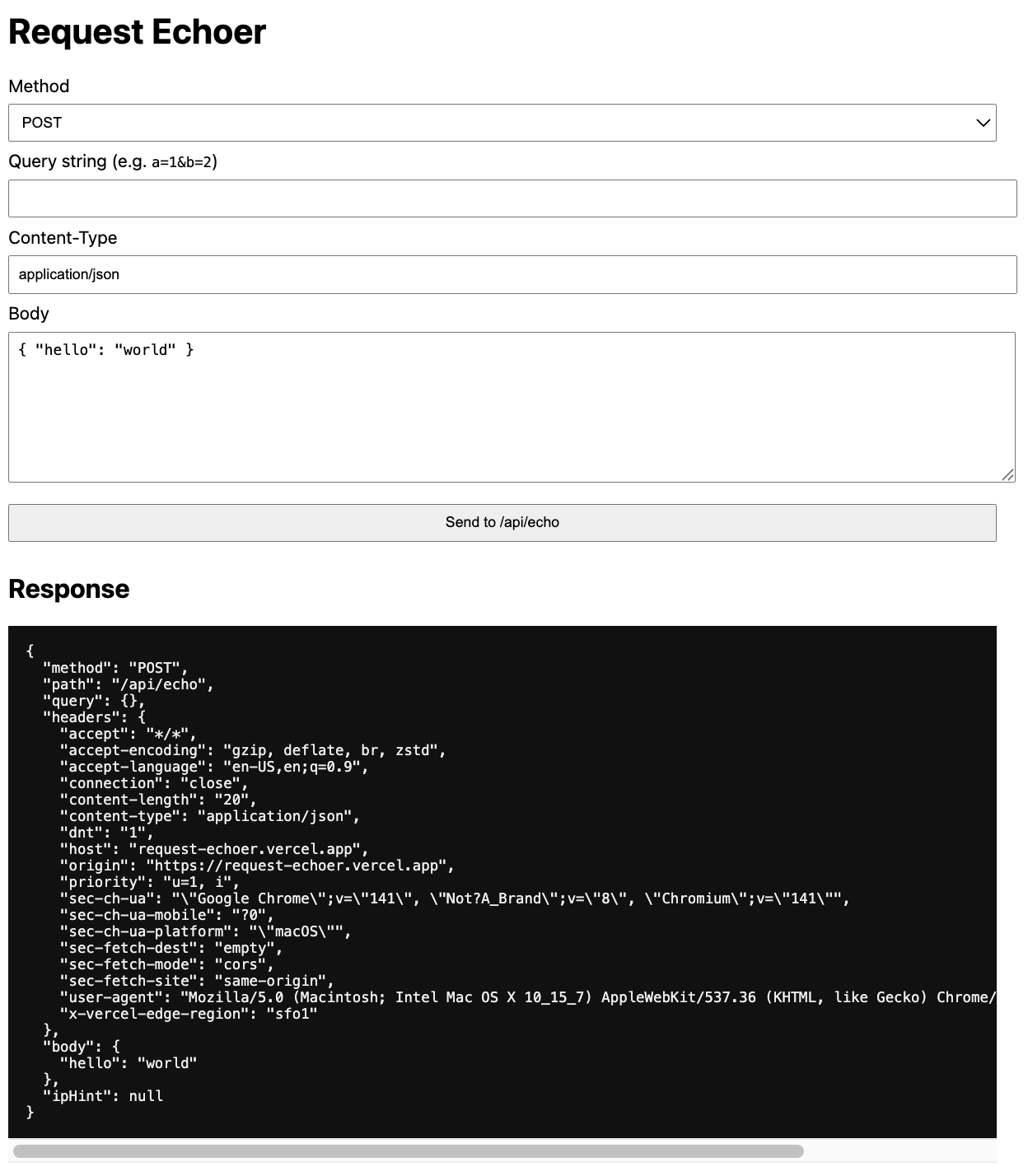
I built a minimal HTTP debugging tool that echoes back request metadata. It’s like httpbin.org but self-hosted on Vercel with built-in safety measures for production use.
Demo: request-echoer.vercel.app
Source: github.com/brianhliou/request-echoer
Why build this?
- Verify what your frontend actually sends (headers, query params, payloads).
- Debug fetch or curl without third-party services.
- Learn how to wire up Vercel Edge Functions + static UI.
- Practice adding basic hardening (redacting secrets, truncating large bodies, strict CORS).
How it works
- UI: A single
index.htmllets you choose method, query string, headers, and body. - Backend:
/api/echois an Edge Function that parses the request and returns JSON. - Security:
- Redacts sensitive headers (
authorization, cookies, API keys). - Removes IP/geo and Vercel-specific tokens.
- Truncates request bodies over 100 KB.
- Enforces an allowlist for CORS.
- Adds default CSP, Referrer-Policy, and MIME-sniffing protections.
- Redacts sensitive headers (
The result is a stateless debugging tool: nothing stored, everything echoed right back.
Example
Run:
curl -s -X POST https://request-echoer.vercel.app/api/echo \
  -H 'Content-Type: application/json' \
  -d '{"hello":"world"}' | jq
Response (simplified):
{
  "method": "POST",
  "path": "/api/echo",
  "headers": {
    "content-type": "application/json",
    "user-agent": "curl/8.4.0"
  },
  "body": { "hello": "world" }
}
Running locally
Clone the repo and run:
npm install
npx vercel dev
Then open http://localhost:3000 in a browser and test the UI.
Deploying to Vercel
- Import the repo into Vercel (Framework Preset: Other).
- Set
ALLOW_ORIGINSin Environment Variables to the domains you trust (comma-separated list, e.g.,https://request-echoer.vercel.app,https://localhost:3000). - Deploy — you’ll get a live subdomain like
https://request-echoer.vercel.app/.
Lessons learned
- Serverless is fast to bootstrap: one static file + one function is enough.
- Echo servers can leak data: OIDC tokens, IP geo, and tracing IDs appear in headers by default. Redaction is essential.
- CORS discipline matters: never respond with
*if you care about safety. - Minimal ≠ careless: even toy apps should apply basic hygiene so you don’t accidentally leak secrets.
This project started as a learning exercise and ended up as a handy utility. Feel free to fork it, improve the UI, or extend the backend to act more like a mini-httpbin.